Personal Area redesign
Reframing account space into a value-driven hub to increase engagement, subscriptions, and basket size

Context
First-time shoppers represent a significant share of growth, but conversion was heavily constrained by early funnel friction. Users were required to register before validating delivery availability, creating uncertainty at a critical decision point.
My role
Led discovery phase strategy
Defined hypotheses, success metrics, and sequencing
Partnered with Product, Engineering and Data analytics
Led end-to-end experimentation strategy
Drove decision-making and rollout recommendation
Context
The Personal Area is a high-intent touchpoint where users manage orders, access savings, and control their account. Over time, it evolved into a fragmented, low-impact space focused on static management rather than influencing behaviour.
This limited its ability to:
Drive repeat engagement
Support subscription and loyalty adoption
Surface savings and promotions
Role: Product Designer (end-to-end)
Collaboration: Product, Data, Research, Customer Support
Type: Concept + pre-validation
Focus: Conversion + engagement
Before
Fragmented experience across orders, loyalty, and account, with no clear prioritisation or visibility of value.


After
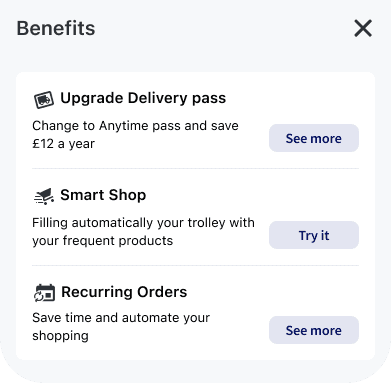
A value-driven hub that surfaces savings, prioritises key actions, and drives repeat engagement and subscriptions.




Goal
Reposition the Personal Area as a value hub that surfaces savings, drives repeat behaviour, and promotes high-value features.
User goals:
Edit orders, reorder quickly
Access savings and subscriptions
Business goals:
Increase Delivery Pass conversion
Grow loyalty participation
Promote coupons and recurring features





Process
Benchmarking: Amazon, Uber, Instacart → action-driven dashboards
Analysis: behavioural patterns and top user actions
Workshop: Aligned on key pillars — savings, control, personalisation, reordering
Exploration: Tested modules for savings, benefits, subscriptions, quick actions